Content note: This article discusses adult sexual practices, BDSM dynamics, and explicit kink activities. It is intended for readers aged 18 and older.
Femdom is short for female dominance — a consensual power-exchange dynamic where a woman takes the dominant role and her partner willingly follows. That last word matters more than anything else in the definition: willingly. Without negotiated consent, it is not femdom; it is just control without agreement.
A few terms you will see immediately in this space:
Domme or Dominant — the woman holding authority in the dynamic
Mistress — a common title used by or for the dominant partner, especially in lifestyle contexts
Dominatrix — typically a paid professional who conducts sessions; distinct from a personal or lifestyle Domme
FLR (Female-Led Relationship) — an ongoing relationship structure where the woman holds primary decision-making authority
One distinction worth locking in early: a professional dominatrix offers paid sessions as a service provider. A lifestyle or personal Domme is in a mutual relationship dynamic with a partner. The two overlap in technique but differ entirely in context. Pornwp, as a curated adult content platform, covers femdom-themed media across its BDSM category — though as this guide makes clear, what you see on screen and what happens in a real negotiated dynamic are two very different things.
The term gets used in at least three distinct ways, and knowing which one someone means changes the conversation entirely.
Couple discussing femdom relationship dynamics
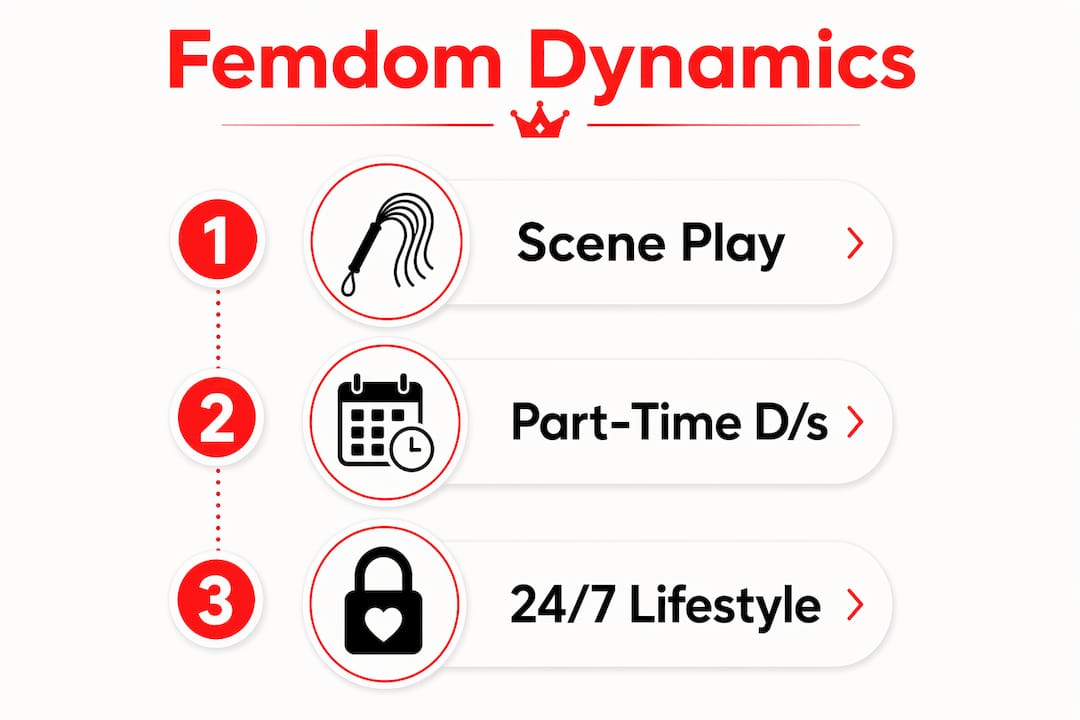
As a single erotic scene: Two people negotiate a power-exchange encounter — she gives commands, he (or they) obeys — and when the scene ends, the dynamic ends with it. No ongoing structure required.
Infographic outlining types of femdom dynamics
As an ongoing D/s relationship: The dominant/submissive roles extend beyond individual scenes. This might mean a partial authority transfer (she makes decisions about specific areas of life, like household tasks or scheduling) or a fuller female-led relationship where her authority is woven into daily routines.
As professional fetish services: A pro-domme conducts paid sessions in a dedicated space. These are service transactions, not romantic relationships, and they operate under their own professional norms and boundaries.
Femdom dynamics range from occasional bedroom-focused power play to 24/7 lifestyle arrangements that extend into daily routines and household decision-making. The word itself appears in porn, erotica, kink community forums, and social media — context shapes meaning every time. Partner gender is also flexible: while the dominant role is female, the submissive partner can be any gender or orientation.
Where did the term come from?
The word "femdom" has documented sexual usage since at least 1986, though the practices it describes are considerably older. The term grew out of BDSM subculture and erotica communities, not mainstream sexual discourse — which explains why so many people encounter it first through adult media rather than through any kind of formal education.
BDSM itself has roots in organized leather and kink communities that became more visible in the United States during the 1970s and 1980s. Female dominance existed within those communities long before it had a tidy abbreviation. The word "femdom" simply gave the concept a portable label that could travel across forums, zines, and eventually the internet.
The problem with media shaping the public image of femdom is that porn optimizes for visual drama, not for accuracy. Leather corsets, elaborate dungeons, and theatrical cruelty make compelling video. They do not represent what most people practicing femdom actually do on a Tuesday evening.
What are common femdom activities?
The range is genuinely wide, and most of it is far less theatrical than adult media suggests. Common practices include:
Roleplay and commands — verbal authority, scripted scenarios, or real-time direction
Bondage and restraint — rope, cuffs, or positional restriction with agreed limits
Orgasm control and chastity — the Domme controls when or whether her partner orgasms, sometimes using a chastity device
Humiliation and verbal dominance — consensual degradation, name-calling, or tasks designed to reinforce the power dynamic
Service and submission tasks — domestic duties, errand running, or acts of devotion assigned by the Domme
Pegging and strap-on play — penetration using a strap-on, a practice that appears frequently in femdom contexts
Sensory play — blindfolds, temperature, texture, or sound used to heighten or restrict sensation
Financial domination (findom) — a dynamic where the submissive transfers money or gifts as an expression of submission
Ritualized service — structured daily acts (morning routines, specific greetings, wardrobe protocols) that reinforce the dynamic outside of explicit scenes
None of these activities imply non-consent. Every item on that list requires prior negotiation, agreed limits, and the ability for either partner to stop at any point.
Pro Tip:Before any scene, write down three things: what you both want to try, what is off-limits for each person, and the exact signal that means "stop everything now." A five-minute written negotiation prevents hours of confusion or harm.
Key terms and the professional vs. personal distinction
Domme — a woman in the dominant role; the feminine form of "Dom"
Mistress — a title of authority used by or for the dominant partner; common in both lifestyle and professional contexts
Dominatrix — typically a paid professional (pro-domme) who conducts sessions; the term is less commonly used within non-professional BDSM communities
Submissive (sub) — the partner who consensually yields authority
Switch — someone who moves between dominant and submissive roles depending on the partner or context
Top/Bottom — Top refers to the person performing an action; Bottom receives it. These are scene-specific terms and do not always map to D/s relationship roles
FLR (Female-Led Relationship) — a relationship structure, not just a scene, where the woman holds primary authority in agreed domains
The clearest practical distinction: a dominatrix is a service provider. You book her, she conducts a session, you pay. A lifestyle Domme is in a relationship — the dynamic is mutual, ongoing, and built on shared investment rather than a transaction. Conflating the two leads to mismatched expectations and, sometimes, real harm.
Consent, safety, and how to do this right
Consent in femdom is not a one-time checkbox. It is ongoing, informed, and revocable at any moment by either partner. Negotiation is not a formality — it is the foundation that makes the rest of the dynamic possible.
SSC vs. RACK
Two frameworks guide most kink communities in the United States:
Framework
Full Name
Core Emphasis
SSC
Safe, Sane, Consensual
Activities should be physically safe, undertaken with sound judgment, and fully agreed upon
RACK
Risk-Aware Consensual Kink
Acknowledges that some kink carries inherent risk; emphasizes informed awareness over the assumption of total safety
Neither framework is universally "correct." Many practitioners use SSC as a starting point and RACK as they gain experience with higher-risk activities. Consent-first frameworks like SSC and RACK, combined with negotiation and aftercare, are standard practice across experienced kink communities.
Pre-scene negotiation checklist
Hard limits (absolute no-go activities for each person)
Soft limits (activities either person is uncertain about — negotiate carefully)
Safeword system (see below)
Health disclosures: medications, injuries, mobility restrictions, mental health considerations
Emergency plan: who to call, where the first-aid kit is, how to exit restraints quickly
Props and equipment check: inspect before use, confirm safe storage
Safeword and aftercare
The traffic-light system is the most widely used: Red means stop immediately, Yellow means slow down or check in, Green means continue. For scenes involving gags or restricted breathing, agree on a physical signal (dropping an object, tapping three times) before the scene begins.
Aftercare follows every scene, regardless of intensity. It typically includes:
Emotional check-in from both partners
Physical care: water, warmth, a blanket if needed
Debrief within 24–48 hours (not immediately after, when emotions are still high)
No major relationship decisions in the hours right after a scene
What are the main types of femdom dynamics?
The structure of a femdom dynamic varies enormously depending on what both partners want and how much of their lives they want it to touch.
Dimension
Scene-Based Play
Part-Time D/s
24/7 Lifestyle
Scope
Single encounter or event
Selected domains (bedroom, household tasks)
All or most areas of daily life
Time commitment
Hours
Days to weeks per cycle
Ongoing, indefinite
Negotiation frequency
Before each scene
Periodic (monthly or quarterly)
Continuous; regular formal check-ins
Typical boundaries
Activity-specific
Role-specific and domain-specific
Comprehensive written agreements common
Scene-based play is the lowest-commitment entry point and the most common starting place for people new to femdom. Part-time D/s relationships extend the dynamic into specific areas — she might control the household schedule but not his professional life, for example. The 24/7 lifestyle arrangement is the most demanding: it requires significant emotional labor from the dominant partner, not just the submissive, and micro-power exchanges — structured small tasks like meal planning, wardrobe protocols, or communication rules — often form its backbone.
Long-term dynamics need periodic renegotiation. What worked at six months may not work at two years. Scheduled check-ins (quarterly is common) give both partners a structured opportunity to adjust without it feeling like a crisis.
On the legal side: in the United States, all BDSM activity between adults must be consensual. Consent cannot be given under duress, intoxication, or coercion. If a dynamic raises questions about legal boundaries — particularly around written agreements, financial arrangements, or physical marks — consulting a kink-aware attorney or therapist is a reasonable step, not an overreaction.
How to get started with femdom safely
Starting slow is not timidity. It is how you build the trust that makes more intense dynamics possible later.
Reflect on your desires and limits first. Before involving a partner, spend time understanding what specifically appeals to you about female dominance, what your hard limits are, and what you are genuinely uncertain about. Journaling helps.
Educate yourself. Read foundational books (The New Topping Book and The New Bottoming Book by Dossie Easton and Janet W. Hardy are standard starting points; SM 101 by Jay Wiseman covers safety in detail). Attend a munch — an informal, non-sexual social gathering for kink-curious people — before any play event.
Have an explicit conversation with your partner. Not a hint, not a suggestion during sex. A dedicated, sober conversation about what you each want, what you are not willing to do, and what you need to feel safe. Psychological and emotional power exchange, rituals, and structure matter far more than props or equipment.
Start with low-risk scenes. Verbal commands, light restraint with a scarf, or a simple task-based dynamic are good first experiments. They build communication habits without high physical stakes.
Debrief and adjust. After each scene or dynamic period, talk about what worked, what did not, and what you want to try differently. This is not optional — it is how the dynamic improves.
A few red flags worth naming: any partner who pressures you to skip negotiation, insists on secrecy from everyone in your life, or escalates intensity faster than you agreed to is not practicing femdom. They are practicing coercion. The kink community has a phrase for this: "BDSM is not a loophole."
Common myths about femdom, corrected
Myth: Femdom is abuse. Clarification: Abuse involves non-consent, coercion, or harm without agreement. Femdom is built on explicit negotiation and the ongoing ability of either partner to stop. The presence of power imbalance does not make something abusive — the absence of consent does.
Myth: Femdom is an ideology of female supremacy. Clarification: Femdom is not an ideology claiming women are superior to men. It is an eroticized power exchange within negotiated boundaries. The dominant role is a chosen dynamic, not a political statement.
Myth: Femdom is always physical or extreme. Clarification: Many femdom dynamics involve no physical play at all. Verbal authority, task assignment, and structured routines are femdom. Integrating femdom into daily life can look like morning check-ins, meal planning authority, or communication protocols — nothing theatrical required.
Myth: Femdom is only for straight men. Clarification: The submissive partner in a femdom dynamic can be any gender or orientation. Queer, nonbinary, and same-sex femdom relationships are common and well-represented in kink communities.
Myth: Porn accurately represents femdom. Clarification: Porn is a performance medium. Scenes are staged, edited, and optimized for visual impact. A beginner mistake is copying professional dominatrix scenes from adult media without building the trust, negotiation skills, and safety protocols that real intimate dynamics require. Watch it for entertainment or inspiration; do not treat it as a how-to manual.
Understanding these distinctions is not just academic. Shame built on myths keeps people from negotiating clearly, which is exactly when dynamics become unsafe.
Where to learn more safely in the United States
Good resources exist. The challenge is vetting them.
Books worth reading first:The New Topping Book and The New Bottoming Book by Dossie Easton and Janet W. Hardy are the most widely recommended starting texts in U.S. kink communities. They cover both the dominant and submissive perspectives with practical, non-judgmental guidance. SM 101 by Jay Wiseman is the go-to reference for physical safety in BDSM activities.
The National Coalition for Sexual Freedom (NCSF): The NCSF is a U.S.-based advocacy organization that supports the rights of consenting adults in BDSM and kink relationships. Their website includes legal resources, a Kink Aware Professionals (KAP) directory of therapists and medical providers who understand kink dynamics without pathologizing them, and incident reporting support.
Kink-aware therapists: The KAP directory (maintained by the NCSF) lists mental health professionals who can help individuals and couples navigate the emotional dimensions of power-exchange relationships without judgment. This is particularly useful for people processing shame, relationship transitions, or trauma adjacent to kink.
Munches and workshops: Munches are informal, public, non-sexual social gatherings organized by local kink communities. They are the safest first step into in-person community. Workshops offered through established organizations (check for a published code of conduct, facilitator credentials, and a clear refund/safety policy) provide hands-on skill-building in a structured environment.
Online communities: Moderated forums and groups exist on several platforms. Look for communities with active moderation, clear rules against harassment, and a culture of consent education — not just fantasy sharing.
Vetting checklist for any instructor or event:
Published code of conduct and safety policy
Verifiable facilitator credentials or community reputation
Clear refund policy
References or reviews from past attendees
No pressure to participate beyond your comfort level
Privacy note: When joining online groups or searching for partners, use a separate email address, avoid sharing your full name or location early, and review privacy settings on any platform before posting.
The psychology behind femdom dynamics
The emotional and psychological dimensions of femdom are often more significant than the physical ones, and they are almost always underestimated by people new to the dynamic.
Therapist consulting patient on femdom psychology
For the dominant partner, holding authority is not passive. It requires attentiveness, decision-making, and emotional labor — reading a partner's state, adjusting intensity, and carrying responsibility for the dynamic's safety. Many Dommes describe the role as demanding in ways that are invisible from the outside.
For the submissive partner, yielding control can produce a state sometimes called "subspace" — a deeply relaxed, sometimes dissociative mental state that results from sustained submission and physical stimulation. It feels profoundly freeing for many people, which is part of why the dynamic is so compelling. It also means the submissive may not be in the best position to assess their own needs immediately after a scene, which is exactly why aftercare exists.
Trust is the actual mechanism. The submissive's willingness to follow depends entirely on confidence that the Domme will not exceed agreed limits. The Domme's ability to lead depends on the submissive's honest communication about their state. Neither role works without the other's investment.
Micro-power exchanges — small, structured daily tasks and rituals — often sustain long-term dynamics more reliably than intense weekend scenes. They keep the dynamic present without requiring constant escalation, and they build the kind of routine trust that makes deeper scenes feel safe when they do happen.
Key Takeaways
Femdom is a consensual female-dominant power exchange that requires explicit negotiation, ongoing communication, and aftercare to be practiced safely and sustainably.
Point
Details
Consent is the foundation
Every femdom dynamic requires negotiated, ongoing, revocable consent — without it, the dynamic is not femdom.
Terminology varies widely
Domme, Mistress, and Dominatrix are not interchangeable; define terms explicitly with any partner before starting.
Dynamics range widely
From a single bedroom scene to a 24/7 lifestyle arrangement — the scope is whatever both partners negotiate.
Start slow and debrief
Begin with low-risk scenes, use a safeword system, and hold a debrief within 48 hours of any scene.
Education before imitation
Read foundational books and attend a munch before trying anything you have only seen in porn.
Why nuance matters more than most guides admit
The conversation around femdom tends to split into two camps: people who treat it as purely a porn category and people who treat it as a serious lifestyle requiring elaborate infrastructure. Both framings miss most of the people actually practicing it.
The reality is that most femdom dynamics are quiet. They look like a partner who defers to her judgment on household decisions, or a weekly ritual that takes ten minutes and costs nothing. The theatrical version — the dungeon, the latex, the elaborate scene — exists and is valid, but it is not the entry point and it is not the norm.
What gets underestimated consistently is the emotional intelligence required from the dominant partner. The submissive's vulnerability is obvious. The Domme's labor is not. She is managing her partner's psychological state, tracking limits in real time, and carrying the weight of decisions that affect someone who has chosen to trust her completely. That is not a power fantasy. That is a responsibility.
The other thing most guides skip: femdom is not a solution to relationship problems. It will not fix communication issues, resolve resentment, or substitute for basic compatibility. Couples who try to use a power-exchange dynamic to patch an underlying problem usually find the dynamic amplifies the problem instead. Start from a foundation of trust and honest communication, and femdom can deepen a relationship significantly. Start from dysfunction, and it tends to accelerate it.
Useful sources and further reading
*[The New Topping Book & The New Bottoming Book](https://www.goodreads.com/book/show/1201354.The_New_Topping_Book)* by Dossie Easton and Janet W. Hardy — the most widely recommended starting texts for anyone entering BDSM from either role. Practical, non-judgmental, and grounded in real community experience.
**SM 101 by Jay Wiseman** — the standard U.S. reference for physical safety in BDSM. Covers equipment, risk mitigation, and emergency protocols in detail.
[National Coalition for Sexual Freedom (NCSF)](https://ncsfreedom.org) — a U.S.-based advocacy organization with legal resources, incident reporting support, and the Kink Aware Professionals (KAP) directory of therapists and medical providers who work with kink-practicing adults without pathologizing them.
Kink Aware Professionals (KAP) directory — accessible through the NCSF website; lists therapists, counselors, and medical providers by state. Useful for anyone navigating the emotional dimensions of a power-exchange relationship or processing experiences related to kink.
Munches and local kink organizations — search for munches in your city through community boards or kink-friendly social platforms. They are public, non-sexual, and the safest first step into in-person community. Vet any event by checking for a published code of conduct and facilitator accountability.
Pornwp — for readers who want curated media examples of femdom-themed content, Pornwp's BDSM category includes a range of scenes across genres. Keep in mind that adult content is produced for entertainment: performers work from scripts, scenes are edited, and what you see is not a template for real-life dynamics. Use it as a reference point for aesthetics and fantasy, not as a negotiation guide.
This article is general educational information, not professional advice. For questions about your specific situation — legal, medical, or psychological — consult a qualified professional or primary source.